
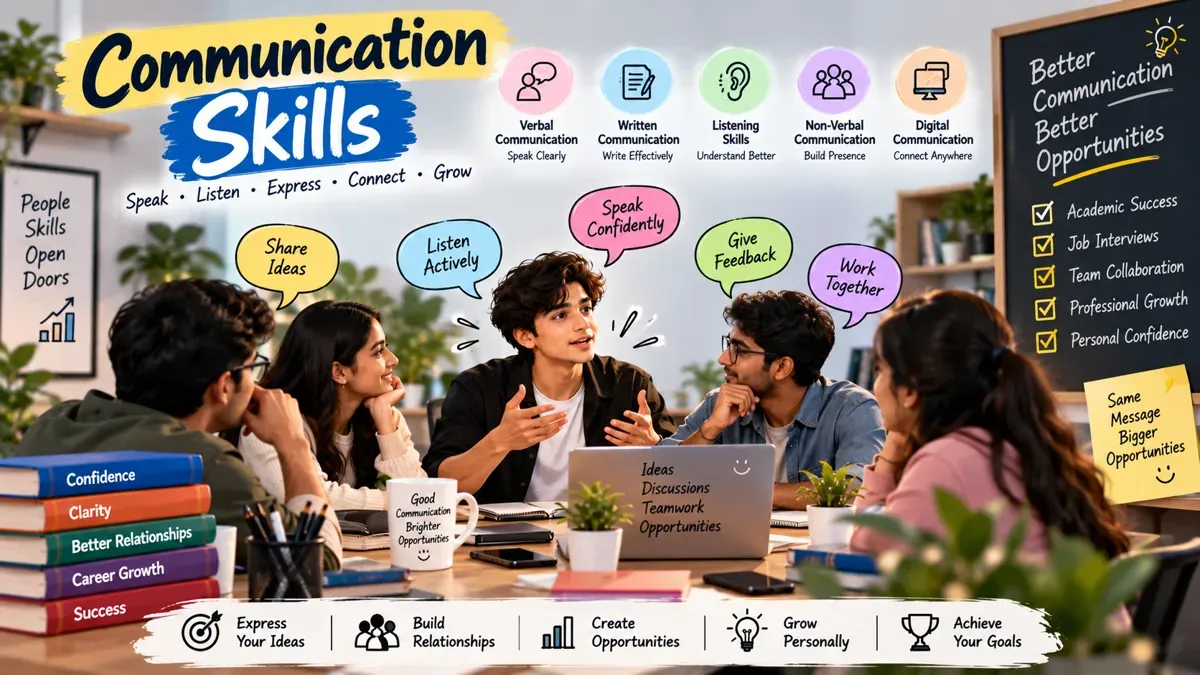
Have you ever felt nervous while speaking in front of a group? Do you sometimes struggle to express your thoughts during an interview or presentation? If yes, you are not alone. Many students and freshers face these challenges when they begin their professional journey.
The ability to communicate clearly is an important skill in education, work, and everyday life. Whether you are attending a college presentation, participating in a group discussion, or preparing for your first job interview, good communication can help you express yourself with confidence.
Communication skills are not just about speaking English fluently. They are about sharing ideas clearly, listening carefully, and understanding others.
In this blog, we will explore what communication skills are, why they matter, the different types of communication, and how students and freshers can improve them.
1. What Are Communication Skills?
Communication skills are the abilities that help people share information, express ideas, understand messages, and interact effectively with others.
Communication can happen through speaking, writing, body language, facial expressions, and listening.
For example, explaining a project to your teacher, writing a professional email, listening to instructions during an internship, or answering questions in an interview are all examples of communication.
Good communication does not mean using difficult words or speaking continuously. It means delivering the right message in a clear, respectful, and understandable way.
2. Why Are Communication Skills Important for Students?
Communication skills play an important role in a student's academic and professional development.
Here are some key benefits of developing strong communication skills.
Improves Confidence
When students learn to express their thoughts clearly, they often become more comfortable participating in discussions, presentations, and interviews.
Regular practice can help reduce nervousness and improve confidence over time.
Helps in Job Interviews
During interviews, employers may ask candidates to explain their education, skills, projects, and career goals.
Clear communication helps candidates present their qualifications and answer questions effectively.
Supports Teamwork
Students often work in groups for projects, assignments, and presentations.
Good communication helps team members share ideas, divide responsibilities, solve problems, and work toward a common goal.
Builds Professional Relationships
In the workplace, communication helps employees interact with colleagues, managers, clients, and customers.
Being polite, respectful, and clear can help build positive professional relationships.
Helps in Academic Performance
Students use communication skills while asking questions, participating in class discussions, explaining concepts, and delivering presentations.
These activities can help them understand subjects better and participate more actively in learning.
3. Types of Communication Skills Every Student Should Know
Communication involves more than speaking. Students should understand different forms of communication and learn when to use them.
A. Verbal Communication
Verbal communication means sharing information through spoken words.
Examples include:
- Classroom discussions
- Job interviews
- Group discussions
- Presentations
- Meetings
- Phone conversations
To improve verbal communication, focus on speaking clearly, organizing your thoughts, and using simple, understandable language.
You do not need a perfect accent to communicate effectively.
B. Non-Verbal Communication
Non-verbal communication involves expressing messages without using spoken words.
It includes:
- Facial expressions
- Eye contact
- Posture
- Hand gestures
- Body movements
For example, maintaining natural eye contact and an attentive posture during an interview can help show that you are engaged in the conversation.
Non-verbal communication should feel natural. Avoid forcing gestures or maintaining uncomfortable eye contact.
C. Written Communication
Written communication means sharing information through written words.
Students and professionals use written communication for emails, reports, assignments, messages, and other documents.
Important written communication skills include:
- Correct spelling and grammar
- Clear sentence structure
- Professional email writing
- Proper formatting
- Organizing information logically
A well-written message should be easy for the reader to understand.
D. Listening Skills
Listening is one of the most important parts of communication.
Good listeners pay attention to the speaker, understand the message, and respond appropriately.
Active listening includes:
- Paying attention without distractions
- Avoiding unnecessary interruptions
- Asking questions when something is unclear
- Understanding the speaker's point of view
- Responding thoughtfully
Listening carefully can prevent misunderstandings and improve teamwork.
E. Digital Communication
Digital communication means interacting through digital tools and online platforms.
Students and freshers may use digital communication during online classes, internships, remote work, and job applications.
Examples include:
- Writing professional emails
- Attending online meetings
- Sending messages through workplace platforms
- Sharing documents
- Communicating through video calls
Always use respectful language and check your message before sending it in a professional setting.
4. How to Improve Communication Skills Step by Step
Communication skills can be developed with regular practice. You do not need to become an expert in one day.
Here are some simple ways to improve your communication abilities.
Step 1: Practice Speaking Every Day
Choose a simple topic and speak about it for two to five minutes.
You can talk about your daily routine, hobbies, education, or career goals.
Try recording your voice and listening to it afterward. Notice whether your thoughts are clear and whether you speak too quickly.
The goal is not perfection. The goal is gradual improvement.
Step 2: Read Regularly
Reading helps you learn new words, understand sentence structure, and organize your thoughts.
You can read:
- Newspapers
- Short stories
- Blogs
- Books
- Educational articles
After reading, try summarizing the main idea in your own words. This can help improve both understanding and speaking ability.
Step 3: Improve Your Listening Skills
Good communication starts with understanding others.
During conversations, avoid checking your phone or thinking only about what you want to say next.
Listen carefully and ask questions if you need clarification.
You can also practice listening through interviews, educational videos, podcasts, and discussions.
Step 4: Learn to Express Ideas Clearly
You do not need complicated vocabulary to communicate effectively.
Use simple words and short sentences when possible.
Before speaking, think about:
- What do I want to say?
- What is the main point?
- How can I explain it simply?
Clear communication is more useful than using difficult words without understanding them.
Step 5: Participate in Group Discussions
Group discussions can help students practice expressing opinions, listening to others, and responding respectfully.
Start by participating in classroom discussions or small group conversations.
Try to support your ideas with examples, avoid interrupting others, and remain open to different viewpoints.
Step 6: Practice Public Speaking
Public speaking can feel challenging, especially for beginners.
Start with small activities, such as speaking in front of friends or presenting a topic to a small group.
Prepare your main points, practice beforehand, and focus on communicating your message rather than worrying about every mistake.
With regular practice, public speaking may become more comfortable.
Step 7: Ask for Feedback
Feedback can help you identify areas for improvement.
Ask a teacher, friend, mentor, or colleague to share honest feedback about your communication.
You can ask whether your message was clear, whether you spoke too quickly, or whether your presentation was easy to follow.
Use the feedback to improve gradually.
5. Communication Skills for Job Interviews
Communication is an important part of the job interview process.
Even when you have the right qualifications, you need to explain your skills, experience, and interests clearly.
Here are some ways to prepare for interviews.
Prepare Your Self-Introduction
Most interviews begin with a question such as "Tell me about yourself."
Prepare a short introduction that includes your educational background, relevant skills, projects or experience, and career interests.
Keep it natural and relevant to the job.
Listen to the Complete Question
Do not rush to answer before the interviewer finishes speaking.
Listen carefully, understand the question, and take a moment to organize your thoughts.
If you do not understand something, politely ask the interviewer to repeat or clarify it.
Give Clear and Relevant Answers
Avoid giving very long answers that move away from the question.
Explain your main point and add a relevant example when useful.
If you do not know the answer to a question, be honest rather than making up information.
Maintain Professional Body Language
Sit comfortably, maintain natural eye contact, and avoid distracting movements.
A calm and attentive posture can help you communicate professionally.
Practice Mock Interviews
Mock interviews allow you to practice answering questions in a realistic setting.
You can practice with a friend, teacher, mentor, or career trainer.
Review your performance and work on areas that need improvement.
6. Communication Skills for Different Career Paths
Different careers require different communication abilities.
Here are some examples of how communication skills can support various professional roles.
| Career Path | Important Communication Skills |
|---|---|
| Business Analyst | Requirement gathering, documentation, presentations |
| Data Analyst | Explaining insights, reporting, presenting findings |
| Digital Marketer | Content writing, client communication, campaign reporting |
| Web Developer | Team collaboration, technical explanations, documentation |
| Customer Support | Active listening, clear speaking, problem resolution |
| IT Support | Explaining technical issues, customer handling, clear instructions |
| Management | Leadership communication, negotiation, teamwork |
Students should focus on communication skills that match their career interests while continuing to develop their overall communication abilities.
7. Common Communication Mistakes to Avoid
While developing communication skills, students may make mistakes that affect how their message is understood.
Here are some common mistakes to avoid:
Speaking too quickly: Slow down enough for others to understand your message.
Interrupting others: Allow people to finish speaking before responding.
Using unnecessarily difficult words: Prefer clear and simple language.
Ignoring body language: Pay attention to your posture, facial expressions, and gestures.
Not listening carefully: Focus on understanding the speaker instead of preparing your reply.
Being afraid of making mistakes: Mistakes are a normal part of learning. Use them as opportunities to improve.
Using unprofessional language in formal situations: Adjust your tone and wording according to the situation.
8. A Simple 7-Day Communication Skills Practice Plan
Students can use this simple plan to begin improving their communication skills.
| Day | Practice Activity |
|---|---|
| Day 1 | Give a two-minute self-introduction |
| Day 2 | Read an article and summarize it aloud |
| Day 3 | Practice writing a professional email |
| Day 4 | Watch a short interview and note communication techniques |
| Day 5 | Participate in a group discussion |
| Day 6 | Practice five common interview questions |
| Day 7 | Record a short presentation and review your progress |
Repeat the activities with new topics and gradually increase the difficulty.
The purpose of this plan is to build a regular practice habit, not to achieve perfect communication in one week.
9. How Vexatry Global Supports Communication Skills Development
At Vexatry Global, we believe communication and practical learning are important parts of career preparation.
Our training and internship initiatives aim to help students develop useful workplace skills, improve their confidence, and understand professional expectations.
Through career-focused learning activities and practical exposure, students can work on communication, teamwork, and other abilities that support their professional development.
Whether you are preparing for your first interview, planning to join an internship, or improving your workplace communication, continuous learning can help you take the next step.
Explore Vexatry Global to learn more about our training, internship, and career development initiatives.
Frequently Asked Questions (FAQs)
1. What are communication skills in simple words?
Communication skills are the abilities that help you express ideas, share information, listen to others, and understand messages clearly.
2. Why are communication skills important for freshers?
Communication skills help freshers participate in interviews, work with teams, explain their abilities, and interact professionally with colleagues and clients.
3. How can students improve communication skills?
Students can improve communication by practicing speaking, reading regularly, listening carefully, participating in group discussions, and asking for feedback.
4. Is English fluency necessary for good communication?
No. Good communication is about expressing ideas clearly and understanding others. English may be required for some roles, but clear communication can be developed in any language.
5. What are the five important communication skills?
Five important communication skills are verbal communication, non-verbal communication, written communication, active listening, and digital communication.
6. How can I improve my communication skills for interviews?
Prepare your self-introduction, practice common interview questions, listen carefully, give clear answers, and participate in mock interviews.
7. Can communication skills be learned?
Yes. Communication skills can be improved through regular practice, feedback, observation, and real-life conversations.
Conclusion
Communication skills are valuable for students, freshers, and professionals across different career paths.
They help you express ideas clearly, understand others, build confidence, and work effectively with people. Whether you are preparing for college presentations, internships, or job interviews, communication skills can support your personal and professional growth.
You do not need to be a perfect speaker to become a good communicator. Start with small steps, practice regularly, listen carefully, and learn from every interaction.
Speak clearly. Listen actively. Communicate confidently. Grow with Vexatry Global.